Problem
Frequent trips, unbalanced loads and unexplained outages.
EmersonEIMS solution
Power-quality study, board audit, protection coordination review.
Business outcome
Stable distribution, fewer nuisance trips.
B2BEmersonEIMS serves commercial, industrial, healthcare, telecom, hospitality, government & contractor clients.• Engineering-led • SLA-backed • Documented commissioning
Keyboard Shortcuts
Design, supply, installation, testing and maintenance of high-voltage and distribution infrastructure for industrial sites, institutions and commercial developments.
Frequent trips, unbalanced loads and unexplained outages.
Power-quality study, board audit, protection coordination review.
Stable distribution, fewer nuisance trips.
Old transformer with no records — insurance and audit risk.
Oil sampling, IR thermography, ratio and insulation testing.
Traceable health record, planned not reactive replacement.
Distribution board built around what was on the shelf.
Engineered DB design with proper protection and segregation.
Safer, easier to maintain, easier to extend.
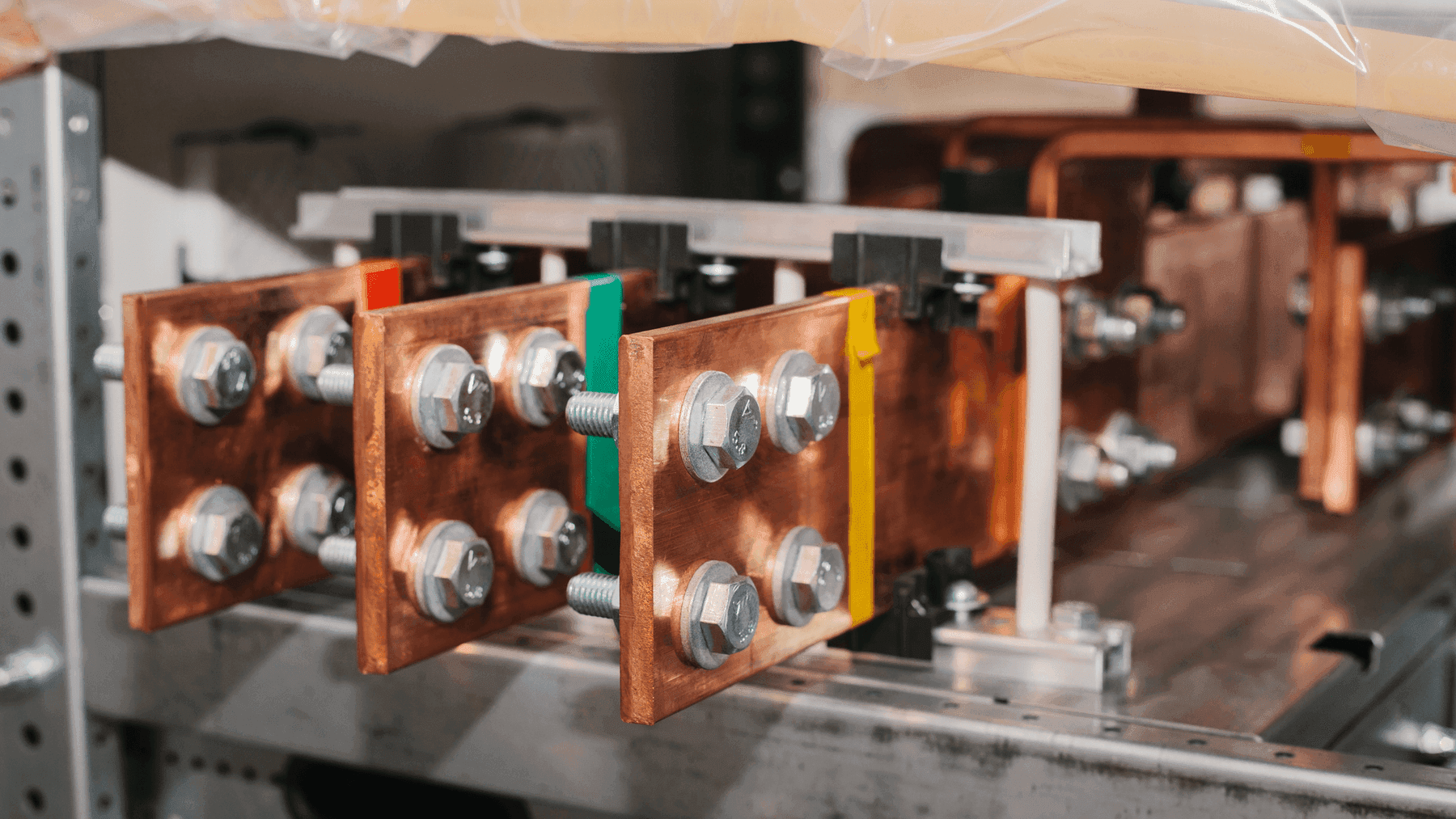
Complete solutions for high voltage electrical infrastructure including transformers, switchgear, substations, and power distribution systems across East Africa. Expert installation, maintenance, and 24/7 emergency support.
High voltage electrical infrastructure forms the backbone of modern power distribution, enabling efficient transmission of electricity from generation sources to end consumers. Our comprehensive solutions cover the entire spectrum from 3.3kV medium voltage systems to 220kV extra high voltage transmission infrastructure.
With over 35 years of experience in the East African power sector, we have established ourselves as the region's leading provider of high voltage equipment, installation, testing, and maintenance services. Our team of certified engineers and technicians brings expertise in handling complex power infrastructure projects.
Transformers are the heart of any electrical distribution system, stepping voltage levels up for efficient long-distance transmission and down for safe utilization. We supply, install, and maintain transformers ranging from 50kVA distribution units to 100MVA power transformers for utility substations.
Switchgear provides essential switching and protection functions, isolating faulty sections and enabling safe maintenance operations. Our portfolio includes vacuum circuit breakers, SF6 switchgear, ring main units, and complete switchboard solutions meeting IEC international standards.
Substations serve as the critical nodes in power networks, housing transformers, switchgear, protection systems, and control equipment. We design, construct, and commission complete substations from compact package units to large outdoor installations handling multiple voltage levels.
Power cables provide the physical link between electrical equipment, carrying high voltage power safely underground or through cable trays. We supply XLPE insulated cables for medium and high voltage applications, along with professional jointing and termination services.
Protection systems safeguard expensive equipment and ensure network stability by detecting and clearing faults within milliseconds. Our solutions include numerical protection relays, current and voltage transformers, and complete protection coordination studies.
Proper grounding and lightning protection are essential for personnel safety and equipment protection. We design and install earthing systems, lightning arresters, and surge protection devices meeting IEEE and IEC standards.
Our services extend beyond equipment supply to include comprehensive testing, commissioning, and preventive maintenance programs. Regular testing ensures equipment reliability and identifies potential issues before they cause costly failures.
We maintain strategic partnerships with leading global manufacturers including ABB, Siemens, Schneider Electric, and local manufacturers, ensuring access to quality equipment with competitive pricing and reliable spare parts availability.
Power failures can have severe consequences. Our emergency team is available 24/7 for critical situations.
Engineering reference
Above 1,000 volts the rules change — clearances, protection and earthing stop being good practice and become the difference between a working substation and a fatality. This is the framework we apply when we design, build and maintain HV intakes, transformers and switchgear for Kenyan industry.
Power is the product of voltage and current, but the losses in a cable rise with the square of the current (I²R). Push the same power at a higher voltage and the current — and therefore the loss and the conductor size — falls dramatically. That single fact is why Kenya's grid steps up to 220 kV and 400 kVfor long-distance transmission (KETRACO), distributes regionally at 66 kV and 33 kV, feeds towns at 11 kV, and only drops to 415/240 V at the customer transformer.
A growing industrial or commercial site eventually outgrows a low-voltage supply: the cable and the KPLC connection charges for a large LV load become uneconomic, and the voltage sags badly at the far end. The fix is a dedicated 11 kV or 33 kV intake with the customer's own transformer — which also unlocks a better tariff band. Knowing when to make that jump, and engineering the intake to KPLC's standards, is most of the value in HV work.
Transmission loss scales with current squared
P_loss = 3 × I² × R (I = P ÷ (√3 × V × PF))
| Voltage | Role | Typical user |
|---|---|---|
| 400 kV / 220 kV | Bulk transmission | KETRACO national grid |
| 132 kV / 66 kV | Sub-transmission | Regional bulk supply points |
| 33 kV | Primary distribution | Large industry, towns |
| 11 kV | Secondary distribution | Factories, malls, estates |
| 415 / 240 V | Utilisation | Final load, sockets, motors |
The transformer is the heart of any HV intake, and it has two distinct loss streams. Iron (no-load) losses are present every second the unit is energised, whether or not it serves any load — magnetising the core. Copper (load) losses rise with the square of the load current. A transformer is most efficient at the load where these two are roughly equal, typically around 40–60% of rating, which is why grossly oversizing a transformer wastes money continuously through standing iron loss.
Sizing means matching the kVA to the present and near-future maximum demand with sensible headroom, allowing for the power factor of the load, and — for sites heavy in VFDs and rectifiers — specifying a K-rated unit built to tolerate harmonic heating. Cooling class (ONAN, ONAF) and the ambient at the site set the real continuous rating; a transformer comfortable in a European basement can run hot in a Mombasa switch-room. We also weigh capitalised loss: over a 25-year life, a cheaper transformer with higher losses can cost far more than a low-loss unit that costs more upfront.
Transformer efficiency at load fraction x
η = (x·S·PF) ÷ (x·S·PF + P_iron + x²·P_cu)
HV switchgear exists to clear faults fast and selectively — to trip the breaker nearest the fault and leave the rest of the plant running. That discrimination (coordination) is set by grading protection relays in time and current, fed by current and voltage transformers (CTs/VTs), so a downstream fault never trips the incomer first. Get the grading wrong and a single cable fault blacks out the whole site; get it right and the plant barely notices.
The graver issue is the arc flash — the explosive release of energy when a fault arcs across HV conductors, reaching temperatures hotter than the sun's surface and producing a pressure blast and shrapnel. IEEE 1584 lets us calculate the incident energy at each panel, define the arc-flash boundary, and label the required PPE. Faster protection settings cut the energy directly, because the energy is the power of the arc times the time the breaker takes to clear it. Designing for low incident energy is a safety duty, not an optional extra, and it is why live HV work is done only by competent persons behind a permit-to-work.
Arc-flash incident energy (principle)
E ∝ I_arc × t_clear
Industrial sites full of motors and welding plant run at a poor power factor, drawing reactive current that does no work but still loads the supply — and KPLC penalises it. Installing a capacitor bank (often automatic, switching steps in and out to track the load) supplies that reactive power locally, lifting the power factor toward unity. The result is a smaller measured demand (kVA), a lower or eliminated reactive-energy charge, less voltage drop, and freed-up transformer and cable capacity.
The catch on modern sites is harmonics: ordinary capacitors can resonate with the harmonics from VFDs and create more trouble than they cure, so we specify detuned (reactor-protected) banks where the harmonic content warrants it. Correcting from 0.75 to 0.95 typically cuts the apparent power by around 20%, and the bank often pays for itself within a year purely on the avoided penalty.
Capacitor kVAr to correct power factor
Q_c = P × (tan φ₁ − tan φ₂)
A substation's earthing system does its most important work in the half-second of a fault. When fault current floods into the ground grid, the soil's resistance creates voltage gradients across the surface — a person can be exposed to a dangerous touch potential (hand to feet) or step potential (foot to foot) even without touching live metal. IEEE 80 lets us design the grid — conductor size, mesh spacing, ground rods — so these potentials stay below what the human body can survive for the fault duration.
Kenyan soils vary enormously, from conductive coastal and black-cotton soils to high-resistivity rock and laterite, so we measure soil resistivity on site rather than assume it. A low, stable earth resistance also lets the protection see the fault and trip; a poor earth is both a shock hazard and a reason relays fail to operate. Earthing is tested, documented and re-tested — it is not visible, which is exactly why it is so often neglected and so dangerous when it is.
From transformer supply to complete substation construction, we provide end-to-end high voltage solutions across East Africa. Contact us for expert consultation.